|
Local Information
 Our home town, the medieval and historic walled city of
Asti, which lends it's name to some of the regions finest wines, is a
delightful attractive and friendly town with lively outdoor markets, a
wonderful selection of shops, museums and impressive old churches. Our home town, the medieval and historic walled city of
Asti, which lends it's name to some of the regions finest wines, is a
delightful attractive and friendly town with lively outdoor markets, a
wonderful selection of shops, museums and impressive old churches.
Every September Asti holds the Festival di Sagra, a regional three-day
harvest and food fair with a parade of traditional farm activities, the
"Douja D'Or" a weeklong wine tasting festival, and culminates the
festa with a medieval pageant and the famous "Palio", a bareback
horse race around the central Piazza. Although there are other Palios in Italy,
Asti's event is the oldest recorded one.
Thirty kilometres south lies Asti's rival city, Alba, another old city with
roots going back to Roman times, and as well as being the center for the famous
"Barolo" and "Barbaresco" wines is an important town for
the chocolate industry with factories of Rocher and Ferrero (who make
"Nutella"). Alba is also famous for Tartuffi Bianchi (white truffles)
and has a weekend market in October and November attracting many tourists.
However all truffles are found all over the region and almost every town in the
Monferrato holds a "tartuffi' festival in autumn. In fact the later in the
year the better the truffles get.
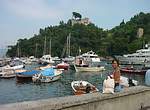
Aqui Terme, is another Roman town, and given its natural hot springs, it
must have been a favourite for weary legionnaires. The town has two natural
"terme" or spa facilities, a huge outdoor swimming pool, a very smart
shopping street, and exudes the relaxed feeling of a spa town
The Langhe, Roero and Monferrato region is sprinkled with hilltop villages
each with its own castle, a reminder of the days when Piedmont was the direct
route of armies marching between Italy and France, a tradition which started
with Hannibal, included Napoleon (his first great victory at Marengo is outside
Allesandria) and only ceased with Italian unification under the House of Savoy.
Each town has its own beautifully decorated church, and boasts of an
"enoteca" (wine store) and at least one excellent restaurant. Some
towns to visit include Agliano Terme (another spa), Nizza Monferatto (an
important market town) Costigliole D'Asti, San Stefano Belbo, Mango, Cocconato,
Gavi and many others. Each town holds its own Sagre festival featuring local
wine or local delicacy, and there is nearly always a festival somewhere every
weekend.
 A few hours drive from Asti to the south on
the spectacular autostrada through the Apennine Mountains brings you to Genoa
and the Liguria region, a long arc of land nestled between the mountains and
the sea. Genoa is a historic seaport, once an important and rich republic the
rival to Venice for influence in the Mediterranean, and the birthplace of
Christopher Columbus. This city, still the biggest seaport in Italy is a
fascinating mixture of new Genoa with its wide boulevards and smart buildings
and old Genoa, a maze of small streets and alleys, the largest old town center
left in Italy, with a real sense of living history. A few hours drive from Asti to the south on
the spectacular autostrada through the Apennine Mountains brings you to Genoa
and the Liguria region, a long arc of land nestled between the mountains and
the sea. Genoa is a historic seaport, once an important and rich republic the
rival to Venice for influence in the Mediterranean, and the birthplace of
Christopher Columbus. This city, still the biggest seaport in Italy is a
fascinating mixture of new Genoa with its wide boulevards and smart buildings
and old Genoa, a maze of small streets and alleys, the largest old town center
left in Italy, with a real sense of living history.
The Ligurian Riveira comprises of two sections, west of Genoa is a string of
beach resorts such as Allassio and San Remo, running all the way to the French
border and beyond to Monte Carlo and the French Riveira. East of Genoa are more
rugged, fishing villages with cliffs dropping into the ocean and famous resorts
such as Santa Margherita and Portofino and the world-famous Cinque Terre
villages. Drive inland from the beaches and in 20 minutes you are in hillsides
with olive groves, vines and old villages looking as if time stopped still.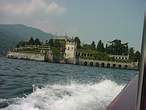
Drive North from Asti through Allesandria and the rice paddies of the River
Po plains, and in an hour you are in the Val D'Aosta, Italy's smallest and most
alpine province, it feels like Switzerland. The Aosta valley has been a natural
passage through the Alps since Roman times, land marked by historical castles
and now it's the on the road leading to the Monte Bianco (Mont Blanc) tunnel
with France. Don't miss Lago Maggiore to the east of Aosta , with the gorgeous
Isola Bella, an entire island landscaped into a baroque garden and palazzo.
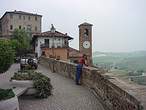 And Turin, our nearest big city, combines a
modern city known for its auto and film industries with the grace of the former
seat of the Royal House of Savoy, who became the Royal family of Italy after
the countries' unification in the 19th century. And Turin, our nearest big city, combines a
modern city known for its auto and film industries with the grace of the former
seat of the Royal House of Savoy, who became the Royal family of Italy after
the countries' unification in the 19th century.
Turin is a charming city with baroque architecture, wonderful piazzas and
coffee shops, spacious streets lined with porticos, and with the Alps as a
backdrop . There are excellent museums (including the second largest Egyptian
museum in the world, the auto museum of course and a magnificent cinema
museum), many palaces and of course the famous and controversial "Shroud
of Turin" kept in the Duomo. In our opinion it's a wonderful place to
visit, all the better that it doesn't attract as many tourists as Rome, Venice
or Florence
And for those with fashion on their minds, we are an hour from Milan, with
its designer boutiques as well as a gorgeous Duomo Cathedral, the incredible
castle, Da Vinci's Last Supper mural and the stupendous art gallery.
Ah so many places to see, please don't rush!
|